
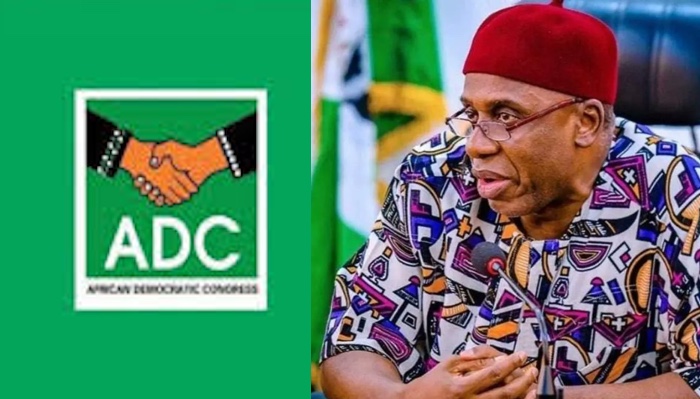
The ADC zoning debate has taken center stage ahead of the 2027 election, with former Minister of Transportation, Rotimi Amaechi, cautioning that selling a northern presidential candidate to southern voters could prove difficult.
Speaking in Kano, Amaechi said while he would support whoever emerges as the African Democratic Congress (ADC) flagbearer, the party must carefully assess zoning realities to enhance its national appeal and electoral viability.
ADC Zoning Debate: Capacity, Age and Power Rotation
Addressing questions about his stance, Amaechi emphasized three key considerations in the ongoing ADC zoning debate:
- Capacity
- Age
- Respect for the current power rotation
He described zoning as an “unwritten law” shaping Nigeria’s political balance, noting that power is presently in the South.
According to him, acknowledging that reality could strengthen the party’s support base in southern Nigeria and reduce resistance among voters who believe power should remain in the region.
Southern Sentiment Could Shape 2027 Election
Amaechi warned that fielding a northern candidate amid strong southern expectations of continued regional leadership may weaken the party’s momentum.
He argued that many southerners would question why zoning principles are reconsidered only when power shifts southward.
Despite his reservations, the former Rivers State governor reaffirmed his commitment to party unity, pledging support for any candidate chosen at the primaries.
His remarks come as President Bola Tinubu of the All Progressives Congress (APC) approaches the midpoint of the widely referenced eight-year southern presidency cycle spanning 2023–2031.
Single-Term Promise and Internal Party Divisions
Amaechi, who has declared his intention to seek the ADC ticket, pledged to serve a single four-year term if elected, allowing power to return to the North.
Similarly, Peter Obi has reiterated his readiness to serve only one term if granted his party’s nomination, aligning with zoning expectations.
However, other influential figures have pushed back against formal zoning within the ADC. Former Kaduna State governor Nasir El-Rufai recently restated the party’s opposition to zoning its presidential ticket.
Former Vice President Atiku Abubakar, considered a leading aspirant, also maintained that the party would not restrict its nomination based on region.
The unfolding ADC zoning debate highlights deeper tensions over regional balance, political strategy, electoral arithmetic, voter sentiment, constitutional conventions, power-sharing norms, national cohesion, campaign messaging, party discipline, democratic inclusion, interregional trust, succession planning, leadership credibility, strategic alliances, grassroots mobilization, policy continuity, institutional stability.
What the ADC Zoning Debate Means for 2027
As the 2027 election approaches, the ADC zoning debate could define the party’s competitive edge and coalition-building strategy.
Whether the ADC prioritizes regional rotation or open contestation may determine its ability to build cross-regional consensus and mount a formidable national challenge.
Ultimately, how the party resolves the ADC zoning debate will shape its credibility, unity, and electoral prospects in Nigeria’s evolving political landscape.


