
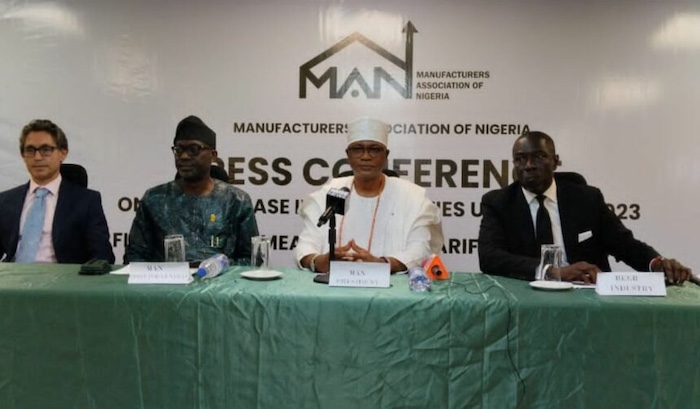
Nearly 12 years after the privatization of Nigeria’s power sector, the Manufacturers Association of Nigeria (MAN) has expressed dissatisfaction with the outcome. MAN claims that the privatisation exercise, which focused on the generation and distribution segments, has proven ineffective, as the beneficiaries lack the necessary technical and financial capacity to optimize power supply.
In a public statement released on Thursday, MAN criticized the continuous increase in electricity tariffs, which it argued has adversely impacted the performance of the manufacturing sector and overall economic growth.
The statement, signed by MAN’s Director-General, Mr. Segun Ajayi-Kadir, called on the government to commission an in-depth review of the performance of power Distribution Companies (DisCos), particularly following the most recent unjustified tariff hike. It also urged the government to assess the impact of these tariff increases on the manufacturing sector, businesses, and households.
Ajayi-Kadir emphasized the need for a critical evaluation of the so-called “cost reflective tariff” framework implemented by the DisCos, questioning their commitment to improving distribution infrastructure and ensuring reliable power supply.
“Electricity is a vital input in the manufacturing process, directly affecting production costs and product prices,” Ajayi-Kadir stated, further underscoring the importance of affordable and stable energy to industrial progress in Nigeria.
In 2013, Nigeria’s power sector was privatized with the goal of improving energy supply, particularly for industries. However, MAN argues that the privatization has not yielded the desired results, attributing the failure to a lack of capacity among operators in the power value chain.
Ajayi-Kadir pointed out that the country’s installed power capacity, estimated at approximately 10,000 megawatts (MW), remains underutilized due to the limited capability of generating and distributing companies to meet national electricity demand.
Despite the ongoing shortfall in supply, electricity tariffs have consistently increased without a corresponding improvement in service quality. Data from the National Bureau of Statistics (NBS) revealed a decrease in electricity supply from 5,909.83 GWh in Q2 2023 to 5,612.52 GWh in Q2 2024, coinciding with the over 230% tariff increase.
MAN has long advocated for an increase in electricity supply, which currently averages just 4,000MW per day for over 200 million Nigerians. According to Ajayi-Kadir, Nigeria needs at least 30,000MW to adequately meet the growing demand from businesses and households.
Ajayi-Kadir also cautioned the government against any further increases in electricity tariffs, stating that such moves would harm the competitiveness of Nigerian businesses, raise production costs, worsen inflation, and strain the disposable income of ordinary Nigerians.
“If the government agrees to another tariff hike, it will severely exacerbate the challenges faced by manufacturers,” Ajayi-Kadir warned, noting that increased tariffs would lead to higher costs that cannot be passed on to consumers, who are already dealing with low purchasing power.
The MAN Director-General further emphasized that continual tariff hikes would hinder the growth of the manufacturing sector, slow economic development, and result in more business closures and rising unemployment.
He concluded by stressing the importance of energy security, stating that no nation can achieve significant industrial development without reliable, affordable, and sustainable energy. He added that low-cost energy is essential for fostering large-scale production and maintaining industrial competitiveness.


