
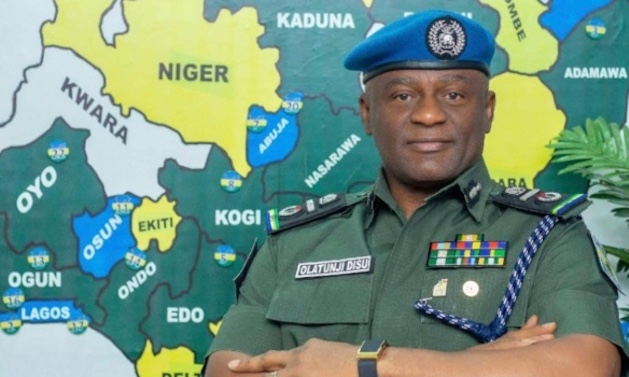

State police will improve community policing, Inspector-General of Police Tunji Disu has said, expressing confidence that decentralised policing would strengthen intelligence gathering, enhance public trust and bring law enforcement closer to local communities.
Speaking during an interview with the News Agency of Nigeria (NAN) on the sidelines of the United Nations Chiefs of Police Summit in New York, Disu said Nigeria was carefully studying the proposed policing model before its full implementation. He also assured the international community that Nigeria remains safe for citizens, investors and visitors despite ongoing security challenges in some parts of the country.
State Police Will Improve Community Policing Through Local Intelligence
Disu said the introduction of state police would help officers build stronger relationships with residents and improve community-based intelligence, making it easier to detect and prevent crime.
According to him, the initiative remains at an early stage and will require extensive consultations, professional training and comparative studies of countries where state policing is already in operation.
He said closer engagement between security personnel and local communities would encourage public cooperation, improve trust and enable faster responses to emerging security threats.
Collaboration Between Federal and State Security Agencies
The Inspector-General noted that state police would complement existing federal policing structures rather than replace them.
He explained that stronger collaboration between federal and state security institutions would improve coordination, information sharing and operational effectiveness in addressing insecurity across the country.
Nigeria Reaffirms Commitment to Global Peacekeeping
During the summit at the United Nations headquarters, Disu highlighted Nigeria’s long-standing role in international peacekeeping operations.
He said Nigeria has consistently contributed troops and police personnel to United Nations missions since participating in its first peacekeeping operation in Congo in 1960.
According to the police chief, Nigerian officers have served with distinction in numerous UN missions, while many have made the ultimate sacrifice in the course of maintaining global peace.
He described Nigeria as one of the United Nations’ most dependable peacekeeping partners, citing decades of sustained contributions to international security efforts.
IGP Assures Investors and Visitors on Nigeria’s Security
Disu also sought to reassure foreign investors and the international community about security conditions in Nigeria.
He acknowledged that insurgency, banditry and kidnapping remain significant concerns in certain regions but said these challenges are concentrated in specific locations and are partly linked to wider instability across the Sahel region.
The Inspector-General stressed that the Nigeria Police Force and other security agencies continue to carry out daily operations aimed at protecting lives, securing communities and restoring lasting peace nationwide.
Police Expand Use of Artificial Intelligence and Technology
The police chief said the Nigeria Police Force is increasingly relying on modern technology to combat crime and improve operational efficiency.
He disclosed that the Force has adopted Artificial Intelligence, digital surveillance systems, data analytics and drone technology to strengthen intelligence-led policing.
According to Disu, analysing crime data enables security agencies to identify emerging threats, predict criminal patterns and deploy personnel more effectively.
He added that technology-driven policing is becoming a key component of Nigeria’s strategy to combat terrorism, kidnapping, banditry and other evolving security threats.
Why the Development Matters
The debate over state police has remained one of Nigeria’s most significant security policy discussions in recent years.
Supporters argue that decentralised policing could improve local intelligence, speed up emergency responses and strengthen accountability, while critics continue to raise concerns about funding, constitutional safeguards and possible political interference.
Disu’s comments indicate that the Nigeria Police Force is preparing for a carefully managed implementation process that prioritises institutional capacity and international best practices.
The state police will improve community policing initiative, according to Inspector-General Tunji Disu, has the potential to strengthen intelligence gathering, deepen public confidence and enhance collaboration among security agencies. He also reaffirmed Nigeria’s commitment to global peacekeeping and highlighted the growing use of advanced technology in tackling terrorism, banditry, kidnapping and other security threats.