
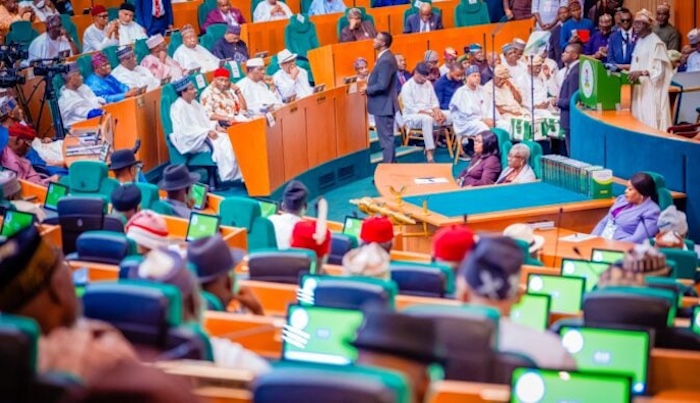
Nigeria’s National Assembly has increased the 2026 Appropriation Bill to N68.323 trillion amid rising oil revenues linked to the Middle East conflict. Lawmakers also advanced approval processes for fresh external borrowings totalling $6 billion requested by President Bola Tinubu, sparking concerns over debt sustainability.
Budget Expansion Driven by Oil Windfall
Nigeria’s federal lawmakers have significantly revised the 2026 fiscal framework, raising the budget from an initial N58.18 trillion proposal to N68.323 trillion.
The adjustment follows a surge in global oil prices triggered by the US-Israel war on Iran, which has pushed Brent crude prices from the budget benchmark of $64.85 per barrel to about $115 per barrel.
With daily oil production projected at 1.84 million barrels, the country is currently generating revenues well above initial projections.
Despite the windfall, the National Assembly opted for increased spending rather than savings, adopting what analysts describe as an expansionary fiscal approach.
Breakdown of Revised 2026 Budget
The approved N68.323 trillion budget allocates:
- N4.799 trillion for statutory transfers
- N15.809 trillion for debt servicing
- N15.427 trillion for recurrent (non-debt) expenditure
- N32.287 trillion for capital projects
Lawmakers said the increase was necessary to accommodate N7.71 trillion in outstanding capital obligations carried over from the 2025 budget, many of which were delayed due to revenue shortfalls and administrative bottlenecks.
Infrastructure, Health and Judiciary Get Boost
The revised budget prioritises infrastructure development, with significant allocations for rail projects connecting Lagos, Kano, Kaduna, and Ogun states under federal equity contributions.
Additional funding was earmarked for feasibility studies on major transport corridors, including the Calabar–Maiduguri route and a proposed superhighway linking Maiduguri to Sokoto.
The health sector received an additional $344.83 million (about N482.76 billion) to support bilateral healthcare initiatives.
The judiciary also secured increased funding, including allocations for the Court of Appeal and Supreme Court, alongside provisions to expand judicial capacity ahead of the 2027 elections.
Lawmakers Approve New Borrowing Plans
To finance the expanded budget, the National Assembly approved a mix of revenue measures and borrowing, including an increase in the oil benchmark expected to generate an additional N2.592 trillion.
However, a major component of the financing plan is fresh external borrowing.
President Bola Ahmed Tinubu requested approval for loans totalling $6 billion, including:
- A $5 billion facility from First Abu Dhabi Bank under a structured financing programme
- A $1 billion loan backed by UK Export Finance for the rehabilitation of Apapa and Tin Can Island ports
The president said the loans would support budget implementation, refinance existing debts, and fund critical infrastructure.
Nigeria’s public debt is currently estimated at about $115 billion, with debt servicing projected at N20.5 trillion in 2026.
Concerns Over Debt and Legislative Oversight
The borrowing plan has drawn criticism from opposition figures, including former Vice President Atiku Abubakar.
Reacting to reports that the Senate approved the loan request within hours of its presentation, Atiku described the process as alarming and lacking due diligence.
“Borrowing decisions that will bind future generations must not be treated with casual urgency,” he said in a statement issued by his aide, Phrank Shaibu.
He warned that Nigeria’s growing reliance on borrowing to finance budget deficits and service existing debt reflects deeper structural challenges in fiscal management.
Lawmakers Defend Fiscal Strategy
Despite concerns, legislators defended the revised budget, describing it as a necessary step to stabilise the economy, address legacy obligations, and stimulate growth through infrastructure investment.
Senate Committee on Appropriations Chairman Olamilekan Adeola said the budget strikes a balance between fiscal responsibility and development needs.
The 2026 fiscal plan, themed “Budget of Consolidation, Renewed Resilience and Shared Prosperity,” is expected to drive economic growth, improve investment conditions, and create jobs.
Implementation Challenges Highlighted
Lawmakers also acknowledged persistent implementation issues in previous budgets, including delays in fund releases and administrative inefficiencies.
To address this, they called for stronger collaboration between the executive and legislature, improved oversight, and strict adherence to timelines.
The National Assembly further approved the extension of the 2025 budget implementation to June 30, 2026, to allow completion of ongoing projects.


