
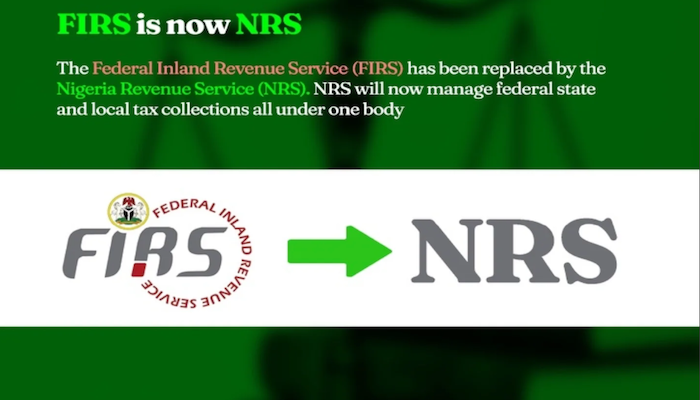

The Federal Inland Revenue Service (FIRS) has officially been rebranded as the Nigeria Revenue Service (NRS), marking a major shift in Nigeria’s revenue administration framework as newly enacted tax laws come into force.
The transformation follows the signing of the Nigeria Revenue Service (Establishment) Act, 2025 by President Bola Ahmed Tinubu in June 2025, with the new agency formally commencing operations on Thursday.
NRS Unveils New Identity in Abuja
Speaking at the unveiling of the NRS logo in Abuja, Executive Chairman Zacch Adedeji described the new brand identity as a significant milestone in the evolution of Nigeria’s tax administration system.
According to Adedeji, the new identity reflects renewed commitment to efficiency, service delivery, transparency, and alignment with global best practices, while maintaining continuity in institutional purpose.
He said the transition signals a forward-looking approach to supporting taxpayers and driving national development through a more unified revenue system.
Court Clears Way for Tax Law Implementation
The unveiling came as the Federal Capital Territory High Court dismissed a request seeking to halt the implementation of the new tax regime scheduled to commence on January 1, 2026.
In his ruling, Justice Bello Kawu declined an application for interim injunction, holding that the court lacked the authority to stop the enforcement of a law already signed by the appropriate authority without concrete evidence of wrongdoing.
The judge directed the federal government to proceed with full implementation of the Nigeria Tax Act, 2025 and related legislation pending the hearing of the substantive suit, which has been adjourned to January 9, 2026.
Legal Challenge and Government Response
The suit was filed by a public interest group, the Incorporated Trustees of African Initiative for Abuse of Public Trust, which alleged discrepancies in the newly enacted tax laws and sought to restrain their enforcement.
Defendants in the case include the Federal Republic of Nigeria, the President, the Attorney General of the Federation, leadership of the National Assembly, and relevant government institutions.
President Tinubu had earlier reaffirmed the federal government’s commitment to implementing the tax reforms despite controversy surrounding the legislation.
Budget Office Defends Integrity of Tax Laws
Meanwhile, the Budget Office of the Federation (BoF) reaffirmed the integrity of the Tax Reform Acts, warning against governance driven by speculation and unverified claims.
Director-General Tanimu Yakubu stressed that the sanctity of duly enacted laws is central to constitutional democracy and cautioned that allegations of post-passage alterations, if unsupported, could undermine public trust and investor confidence.
The BoF welcomed the National Assembly’s decision to investigate the claims and called for verified legislative texts, transparent clarification processes, and alignment of all implementing regulations with authenticated laws.
The office further warned against suspending reforms that are critical to fiscal stability, reduced borrowing, and sustainable economic planning.