
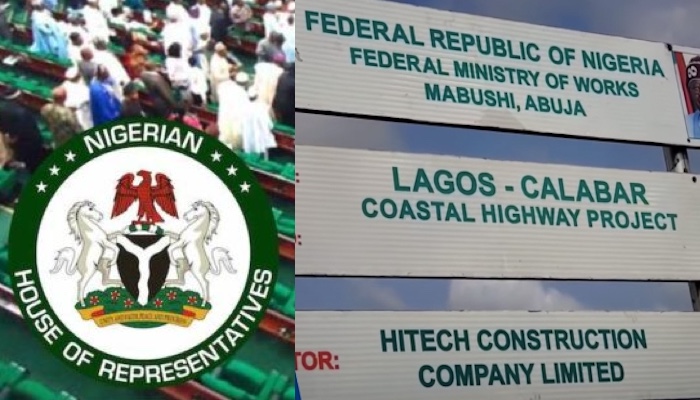

Nigeria’s House of Representatives has launched an investigation into the procurement process and contract award for the Lagos-Calabar Coastal Highway, following concerns over compliance with regulatory procedures. The decision came after a motion was adopted at the plenary session led by Hon. Dr. Austin Achado.
The project, awarded to Hitech Construction Company Nigeria Limited, aims to construct a 700km coastal road and rail using reinforced concrete technology. Estimated at N4.329 billion per kilometer, the project includes features such as 10 lanes, rail tracks, service ducts, street lights, and drainage systems. The financing structure involves a public-private partnership, with the federal government providing 15 to 30 percent co-financing, and the private sector covering the remainder through tolling the road for 15 years upon completion.
However, concerns have been raised regarding the procurement strategy’s compliance with the Infrastructure Concession and Regulatory Commission Act 2005. The Act mandates open competitive bidding for infrastructure projects, with direct negotiations permitted only after exhausting competitive bidding processes.
In response to these concerns, the House has summoned Minister of Works Dave Umahi, Minister of Finance, and the Attorney-General of the Federation to ensure proper documentation and approval of guarantees and credit enhancement instruments for the project.
Meanwhile, the pan-Yoruba socio-political group, Afenifere, has urged the federal government to reconsider the project’s continuation. Expressing dismay over the government’s persistence despite objections, Afenifere highlighted environmental and economic concerns associated with the project. They argue that the $13 billion Lagos-Calabar Coastal Highway project undermines the $12 billion Lagos-Calabar railway project, which they consider crucial for Southern Nigeria’s economic development.
Afenifere emphasizes the project’s potential environmental impact, citing the need for an Environmental Impact Assessment (EIA) report under the EIA Decree No. 86 of 1992. They assert that the project’s commencement without a comprehensive EIA violates environmental regulations and threatens coastal ecosystems.
In conclusion, the House of Representatives’ probe reflects concerns over the procurement process, while Afenifere’s statement underscores broader environmental and economic implications, urging a thorough review of the Lagos-Calabar Coastal Highway project.