
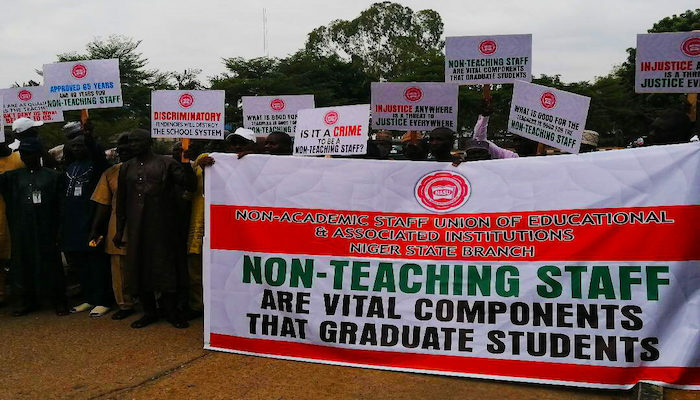

The federal government has implored non-teaching staff in federal universities to refrain from commencing a warning strike scheduled to begin on Monday. The government cited ongoing efforts to address the concerns raised by the Senior Staff Association of Nigerian Universities (SSANU) and Non-Academic Staff Union of Educational and Associated Institutions (NASU) through dialogue.
According to Emameh Gabriel, the Special Adviser on Media to the Minister of State for Labour and Employment, the government has initiated communication with the affected unions and has called for a meeting to discuss their grievances. Gabriel emphasized the importance of adhering to established procedures for resolving issues and highlighted the need for constructive dialogue.
Meanwhile, despite the government’s efforts to avert the strike, the unions have instructed their members to proceed with the one-week warning strike starting from Monday. This decision comes in response to the non-payment of four months’ withheld salaries, which had been approved by President Bola Tinubu.
In a circular issued by the Joint Action Committee (JAC) of SSANU and NASU, dated March 18, 2024, the unions expressed disappointment over the government’s failure to address their demands. They highlighted the urgency of the situation and directed members to embark on the warning strike to compel the government to act.
Among the unions’ demands are the implementation of wage increases agreed upon in 2023 and the payment of withheld salaries. They emphasized the detrimental impact of the delay in implementing these agreements on their members’ livelihoods.
SSANU further called on the government to expedite action on renegotiating the national minimum wage and to address outstanding allowances owed to members. The union stressed the need for timely action to mitigate the effects of hyperinflation on workers’ purchasing power.
In light of these developments, the federal government is urged to prioritize negotiations and engage in meaningful dialogue with the unions to find lasting solutions to the issues at hand. Failure to address the concerns raised by the non-teaching staff could lead to further disruptions in the education sector.