
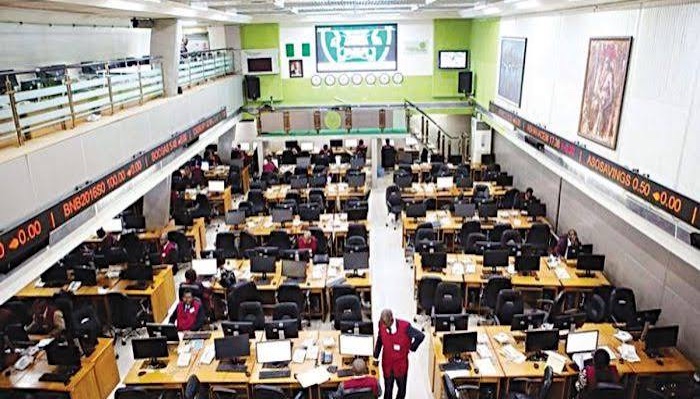
The Nigerian stock market gains N9.3 trillion in market value within one trading week as renewed foreign investor optimism and improving macroeconomic indicators fueled a broad rally on the Nigerian Exchange Limited (NGX).
The surge followed S&P Dow Jones Indices’ decision to place Nigeria on its 2027 watchlist for a possible return to Frontier Market status, a move widely viewed as a positive signal for global investors. At the same time, Nigeria’s external reserves continued their upward trend, reinforcing confidence in the country’s economic outlook.
Nigerian Stock Market Gains N9.3 Trillion on Strong Buying Interest
Trading data from the NGX showed that the market capitalization of listed companies climbed from ₦147.25 trillion at the beginning of the week to ₦156.55 trillion at Friday’s close, representing a gain of approximately ₦9.3 trillion, or 6.4 percent.
The benchmark NGX All-Share Index also posted an impressive performance, rising by 14,558.42 points, or 6.35 percent, to settle at 243,798.76 basis points, compared with 229,240.34 basis points recorded at the start of the week.
Investors increased demand for fundamentally strong companies, with major gains recorded by blue-chip stocks including Dangote Cement, MTN Nigeria Communications Plc, Aradel Holdings Plc and Airtel Africa Plc.
Industrial, Banking and Oil Indices Lead Weekly Rally
Sectoral indices closed the week higher, reflecting widespread investor participation across the market.
The NGX Industrial Goods Index recorded the strongest performance, advancing 10.46 percent week-on-week to 10,713.01 points.
Similarly, the NGX Oil and Gas Index appreciated 8.11 percent, while the NGX Banking Index gained 4.78 percent, highlighting strong buying interest in key sectors of the Nigerian economy.
S&P Dow Jones Watchlist Boosts Foreign Investor Sentiment
Market analysts linked much of the renewed optimism to S&P Dow Jones Indices’ decision to include Nigeria on its Country Classification Watchlist for possible reclassification as a Frontier Market in 2027.
Although the announcement does not immediately restore Nigeria’s Frontier Market status, it reflects growing international recognition of reforms aimed at strengthening market transparency, improving regulatory oversight and enhancing investor protection.
A return to Frontier Market status could increase Nigeria’s visibility among global institutional investors and potentially attract additional foreign portfolio investment into the country’s capital market.
Investors Position Ahead of Second-Quarter Earnings
Managing Director and Chief Executive Officer of Globalview Capital Limited, Aruna Kebira, said many investors were building positions ahead of the release of companies’ second-quarter financial results.
Market participants generally expect strong corporate earnings from several listed companies, encouraging increased investment in fundamentally sound stocks.
External Reserves Reach Two-Year High
Nigeria’s foreign exchange reserves also continued their steady recovery, adding to positive market sentiment.
According to data released by the Central Bank of Nigeria (CBN), the country’s external reserves rose to $51.74 billion as of July 9, 2026, extending a two-month growth streak.
The reserves increased by $3.42 billion, or 7.1 percent, from $48.32 billion recorded on May 6, 2026.
Compared with $37.33 billion reported on July 9, 2025, the reserves have expanded by $14.41 billion, representing a year-on-year increase of 38.6 percent.
Analysts attribute the sustained improvement to stronger foreign exchange inflows, ongoing foreign exchange reforms and improved investor confidence in Nigeria’s economy.
Naira Ends Week Slightly Weaker
Despite the bullish performance in equities and stronger external reserves, the naira closed the week with modest losses against the US dollar.
At the Nigerian Foreign Exchange Market (NFEM), the local currency weakened slightly to ₦1,379.60 per dollar, compared with ₦1,378.40 recorded the previous trading session.
The parallel market also recorded a mild depreciation, with the exchange rate moving from around ₦1,420 per dollar at the start of the week to approximately ₦1,430 per dollar by Friday.
Why This Matters
The combination of a stronger stock market, rising external reserves and renewed international investor interest suggests improving confidence in Nigeria’s financial markets.
If these trends continue alongside economic reforms, Nigeria could attract increased foreign investment, deepen liquidity in the capital market and strengthen overall economic stability.
Conclusion
The Nigerian stock market gains N9.3 trillion marks one of the strongest weekly performances on the NGX in recent months. Supported by S&P Dow Jones’ positive outlook, rising external reserves and expectations of robust corporate earnings, investors are increasingly optimistic about the market’s medium-term prospects despite continued pressure on the naira.


