
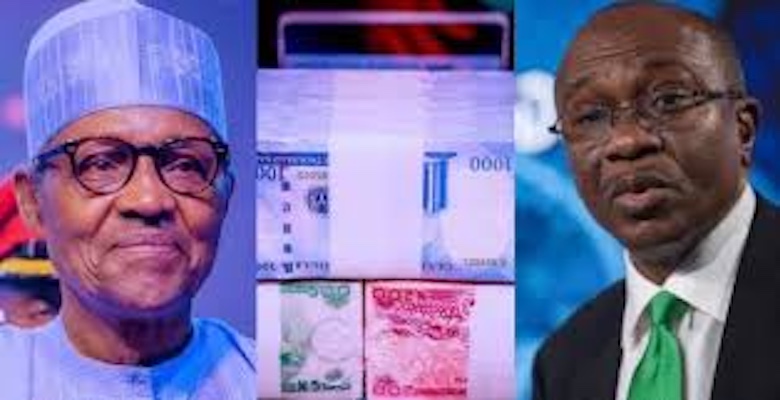
An EFCC investigator has told a Federal Capital Territory High Court that former President Muhammadu Buhari approved the 2022 naira redesign and its local production. The testimony came during the ongoing trial of former CBN Governor Godwin Emefiele over alleged violations of financial regulations.
A prosecution witness has confirmed before the Federal Capital Territory (FCT) High Court in Abuja that former President Muhammadu Buhari approved the redesign of Nigeria’s naira notes and their local production in 2022.
EFCC Witness Testifies in Court
The witness, Chinedu Emere Eneanya, an investigator with the Economic and Financial Crimes Commission (EFCC), gave the testimony on Wednesday during proceedings in the trial of former Central Bank Governor Godwin Emefiele.
The case is being heard before Justice Maryanne Anenih at the FCT High Court in Maitama, Abuja.
Emefiele is facing a four-count charge related to alleged disobedience to lawful directives and actions said to have caused public harm in connection with the naira redesign policy.
Charges Against Emefiele
According to the EFCC, Emefiele allegedly violated provisions of the Central Bank of Nigeria (CBN) Act by approving the printing of over 375 million redesigned N1,000 notes valued at more than N11 billion without proper recommendations from the CBN board and strict presidential approval.
The charges, filed under case number FCT/HC/CR/264/2024, cite alleged breaches of Section 123 of the Penal Code. The former CBN governor has pleaded not guilty and was granted bail.
Approval Granted but Process Questioned
During cross-examination, Eneanya stated that Buhari approved the redesign after reviewing a memorandum submitted by Emefiele, which included sample designs of the N200, N500, and N1,000 notes.
However, the witness told the court that the notes eventually produced differed from the samples presented to the president.
“The president approved the design and directed local production, but what was produced was not the same as what was shown,” Eneanya said.
He added that the redesigned notes were produced locally by the Nigerian Security Printing and Minting Company (NSPMC), following presidential directive.
Role of NSPMC and Investigation Findings
Eneanya referenced an extrajudicial statement by NSPMC Managing Director Ahmed Halilu, which was admitted as evidence. According to him, Halilu confirmed that the company carried out the production of the redesigned currency as instructed.
The witness said investigators found no contradictions between Halilu’s statement and other evidence gathered during the probe.
He also confirmed that the Central Bank paid NSPMC for the production of the new notes.
Alleged Breach of CBN Act
Despite acknowledging presidential approval, Eneanya maintained that Emefiele failed to comply with statutory requirements under Section 19 of the CBN Act.
He explained that the law requires a recommendation from the CBN board before any currency redesign is submitted to the president for approval.
“Investigation showed that the defendant disobeyed the provisions of the Act,” he told the court.
No Evidence of Public Petitions
The EFCC witness further stated that he was not aware of any petitions from members of the public regarding the naira redesign.
He clarified that no such complaints were forwarded to his investigative team.
Case Adjourned
Following the proceedings, the court adjourned the matter until May 11 for continuation of trial.
The case remains one of several legal challenges linked to Nigeria’s controversial 2022–2023 naira redesign policy, which had significant economic and social impacts across the country.


